Scale-up by Scaling Out

Scale-Up By Scaling-Out

Pharmaceutical Technology: Innovation Outlook – Scale-up by Scaling Out
Scale-Up By Scaling-Out

Industry standard capacity implementation typically sees a progression from process development (PD) to pilot plant to scale-up or full scale production. While this standard is not going away anytime soon as conventional large-scale production facilities continue to be planned, and PD/pilot activities are certainly not being obsoleted, traditional scale-up is being challenged by scale-out, and the accepted norm of full scale production is shifting. Conventional large scale facilities certainly have their place in biopharmaceutical manufacturing. However, a shift toward flexible manufacturing capacity is an industry trend that provides a litany of benefits for tomorrow’s needs. These include rapid pandemic response, planning for variable production capacity of products predicated on dynamic market demand driven by competition of biosimilars, manufacturing closer to affected populations bases, and ultimately producing drugs for smaller numbers of patients as treatments become more tailored to specific conditions. To accommodate these needs, given advancements in titers from fed-batch processes and the advent of continuous processing, scaling-out via simply replicating a given process at a fixed volume, is often a better and more efficient solution relative to scaling-up.

The move towards treating ever smaller affected population bases, via treatments more specifically tailored to a given ailment, ultimately leads to personalized medicine. The manufacture of these therapies, despite processing commonalities, by nature, requires scaled-out production via replicating a similar process, at a given volume, to a significant degree. Scaling-out benefits from (and to some degree is predicated upon) the employment of single-use systems (SUS). These systems are not new; however, when applied in the context of scaling-out, wherein larger quantities of relatively smaller SUS may be consumed in increasingly complex and critical applications, the associated common challenges can become exacerbated. These challenges include the ability to rapidly and repeatedly deploy SUS, logistics considerations, and the ability to establish a robust supply chain to ensure consistent delivery of product that meets stringent quality specifications. Further, it is critical that suitable products exist in form factors commensurate with the process scale. What may have historically been a small laboratory filter may now be a critical final filter, and therefore needs to be supported in the same manner as its larger, traditional process scale, counterparts. Meissner is addressing this via new small-scale filtration products designed specifically to meet these needs.

Scaled-out processes also benefit from, and often require, enhanced levels of automation. For drug manufacturers, this is predicated by running a greater number of processes, typically concurrently, and perhaps in advanced operational modes. Likewise, the need for increased automation exists within the supply base which supports scaled-out processes, both in terms of providing integrated process solutions, as well as advancements pertaining to consumables manufacturing methods and technology. Common automation drivers for both drug manufacturers and the supply base include achieving higher degrees of process robustness, rapid augmentation of capacity, and the ability to codify additional manufacturing data. Meissner is addressing this by developing highly automated unit processing solutions as well as next generation SUS connection technology that replaces manually assembled mechanical connections with permanent thermal bonds generated via wholly automated processes.

This field is for validation purposes and should be left unchanged.
I would like to receive email notifications regarding new product announcements and industry events.

GEN Roundup

GEN Roundup: Filters' Future Focuses on Functionality

GEN Roundup: Filters’ Future Focuses on Functionality

GEN Roundup: Filters' Future Focuses on Functionality

This Genetic Engineering & Biotechnology News (GEN) article delivers input from bioprocess purification specialists involved in downstream biopharmaceutical production, as they discuss key advances in virus filtration over the last 10 years, with input on what is necessary for successful and economic large-scale filtration. GEN’s expert panel reviews filtration’s triumphs, tradeoffs, and future trials to come.

The panel includes Leesa McBurnie, Meissner Filtration Products’ Manager of Laboratory and Validation Services, as well as input from GE Healthcare Life Sciences, MilliporeSigma, Pall Life Sciences, Sartorius Stedim Biotech, and Spectrum Laboratories.

This field is for validation purposes and should be left unchanged.
I would like to receive email notifications regarding new product announcements and industry events.

INTERPHEX New York 2016

INTERPHEX 2016 Presentations

INTERPHEX New York 2016 Video covers Meissner Filtration Products’ single-use systems and filtration systems innovations to optimize biopharmaceutical manufacturing.

Watch and learn about Meissner’s latest innovations for optimized manufacturing in the biotech and pharmaceutical industry. Max Blomberg, Director of Operations, introduces BioLink® Modular Overmolding – a disruptive technology that unifies all of the benefits of traditional overmolding with the speed and flexability of traditional mechanical connections. Optimized for single-use applications, BioLink® assemblies allow Meissner’s Applications Engineering Team to create single-use assemblies tailored to the specific requirements of the end-user that result in reduced process risk.

Christian Julien, Director of Pharma Process Solutions discusses the FluoroFlex® PVDF biocontainer for applications beyond the limits of traditional polyolefin-based biocontainers. Optimized for the pharmaceutical industry’s most demanding requirements, FluoroFlex® biocontainers open new opportunities for single-use systems. Antioxidant and additive packages are not needed in the manufacture of this film, which makes it an ultraclean alternative to polyolefin films, with an extremely low leachables and extractables profile. The FluoroFlex® biocontainer’s excellent performance in cell culture applications due to the lack of antioxidants is highlighted.

This field is for validation purposes and should be left unchanged.
I would like to receive email notifications regarding new product announcements and industry events.

American Pharmaceutical Review

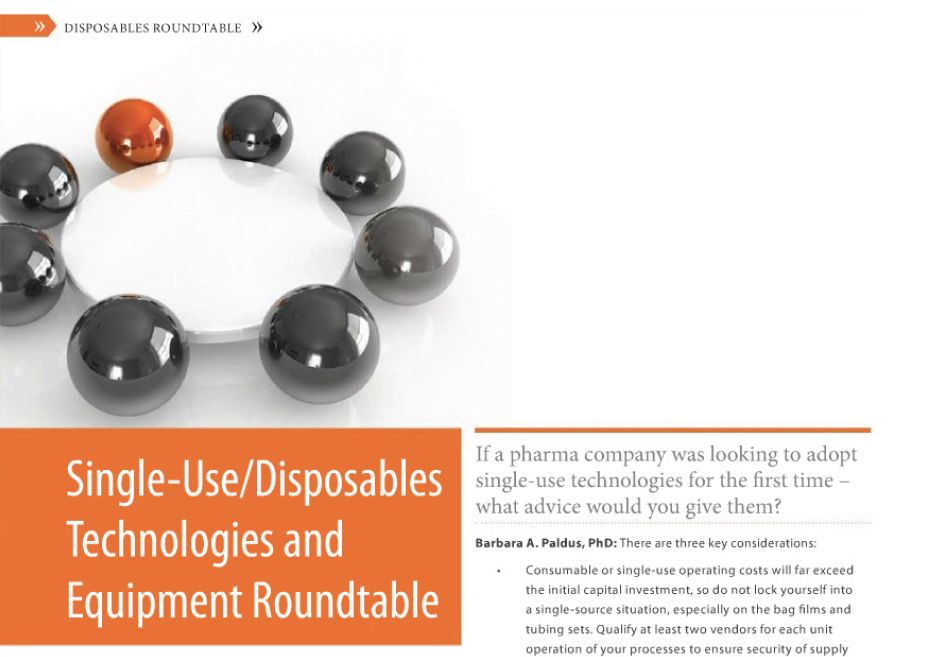
Single-Use/Disposables Technologies and Equipment Roundtable

American Pharmaceutical Review March 2019 Single-Use Roundtable

This American Pharmaceutical Review article discusses the best practices for implementing single-use (disposable) technologies, and the consequences of understanding that as an end-user, you are effectively outsourcing functions were serviced via in-house capacity with traditional systems. The easiest processes to transition to single-use systems are highlighted with a focus on implementing best practices for integrating single-use and stainless steel equipment (hybrid systems). Predictions for the future of single-use systems are discussed. The panel includes Max Blomberg, Director of Operations, and Christian Julien, Director of Pharma Process Solutions, as well as experts from Finesse, BioPlan Associates, Pall Life Sciences, Thermo Fisher Scientific and Ulteemit Bioconsulting.

Sorry, no downloads found.
This field is for validation purposes and should be left unchanged.
I would like to receive email notifications regarding new product announcements and industry events.

Continuous Quality Verification

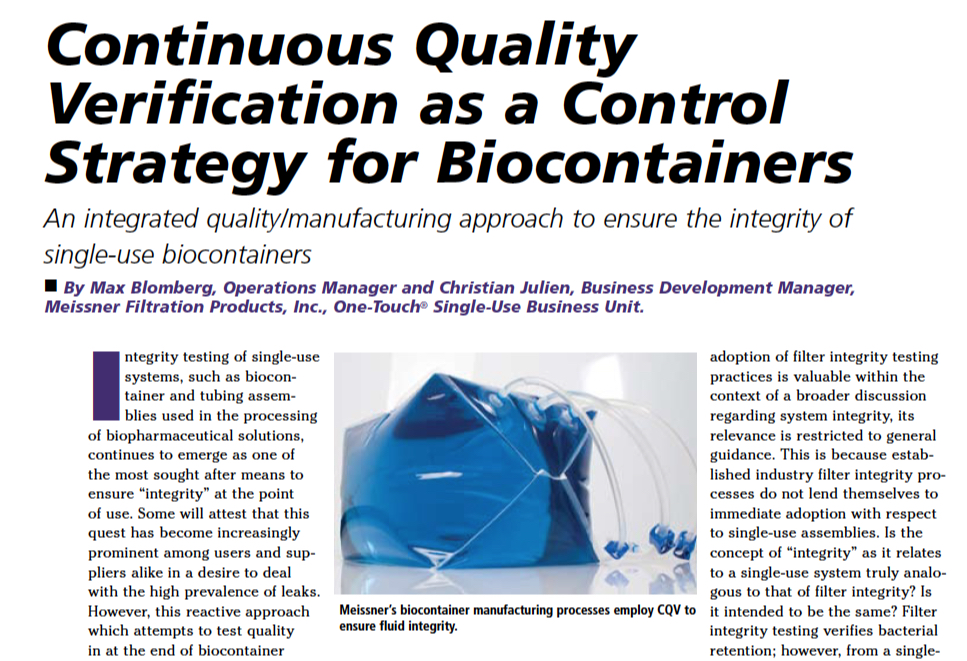
Continuous Quality Verification as a Contronl Strategy for Biocontainers

Pharmaceutical Processing: Continuous Quality Verification as a Control Strategy for Biocontainers

Continuous Quality Verification as a Contronl Strategy for Biocontainers

This Pharmaceutical Processing article discusses a fresh approach to the industry’s discussion around the need to test the integrity of single-use systems, such as biocontainers and tubing assemblies, used in the processing of biopharmaceutical solutions. The reactive approach that attempts to test quality in at the end of biocontainer manufacturing, or post assembly operations, is unlikely to become the answer when it comes to ensuring robust single-use process solutions. With the advent of the ICH Q8 guidance and ASTM E2500 much has been written about its fundamental premise of building quality into a system, i.e. Quality by Design (QbD), versus testing or inspecting it in, commonly referred to as Quality by Inspection (QbI). QbD concepts are not new and have seen tangible implementations in other process industries that require a high level of product robustness. The QbD/QbI discussion can be expanded to the manufacture of single-use products and parallels can be drawn between the control strategies utilized by single-use manufacturers and those applied by drug manufacturers. This article delves further into this approach as a strategy for ensuring quality.

This field is for validation purposes and should be left unchanged.
I would like to receive email notifications regarding new product announcements and industry events.